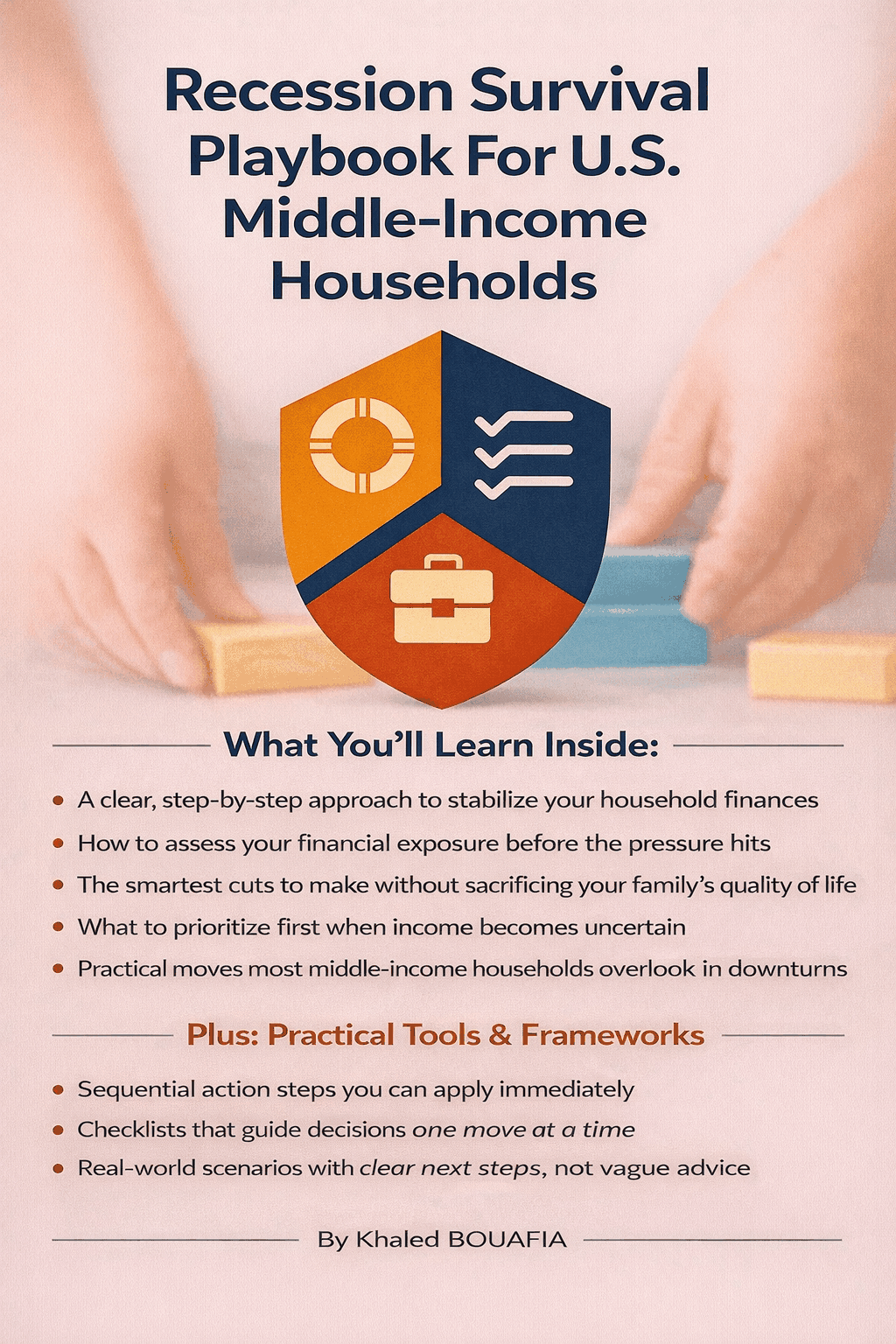
Recession Survival Strategies for Middle-Income Households
Recession Survival Strategies for Middle-Income Households
Couldn't load pickup availability
Recession Survival Strategies for Middle-Income Households
💵 RECESSION SURVIVAL PLAYBOOK FOR U.S. MIDDLE-INCOME HOUSEHOLDS
Stabilize your finances. Protect your income, your family, and your future in just 30 days.
What if the next economic downturn no longer felt like a financial emergency?
No more checking your bank account with anxiety before every bill is due. No more wondering which expenses should be paid first when money feels tighter than usual. No more feeling overwhelmed by rising costs, uncertain job markets, and conflicting financial advice that only creates more stress.
Imagine opening your banking app knowing exactly where your money is going, what needs your attention today, and what can wait until tomorrow. Imagine protecting your household, reducing financial stress, and making confident decisions—even when the economy feels unpredictable.
The Recession Survival Playbook for U.S. Middle-Income Households is a practical, evidence-informed guide designed to help busy households stabilize cash flow, reduce financial pressure, protect employment, and build greater financial resilience during uncertain economic times. Combining emergency budgeting frameworks, expense triage systems, debt prioritization strategies, negotiation scripts, government benefits navigation, side income planning, and practical weekly action plans, this playbook helps you regain financial control without fear, overwhelm, or unnecessary complexity.
WHY FINANCIAL STABILITY FEELS SO HARD DURING A RECESSION
You've probably tried:
- Generic budgeting apps and complicated spreadsheets
- Random money-saving advice from blogs and social media
- Cutting expenses without knowing which bills should come first
- Negotiating with creditors and service providers without preparation
- Searching for government benefits across confusing websites and application processes
- Watching endless side hustle videos that require significant time, money, or specialized skills
The problem isn't your effort.
The problem is uncertainty.
Financial stress creates decision fatigue. Small financial leaks become larger problems when left unaddressed. Families postpone difficult conversations, delay important decisions, and hope next month will somehow look different. Meanwhile, anxiety grows while opportunities to stabilize finances quietly pass by.
This guide replaces uncertainty with a clear, practical, step-by-step plan that combines immediate financial triage, measurable progress, and sustainable systems designed for real-world recession conditions.
WHAT MAKES THIS RECESSION BUDGETING GUIDE DIFFERENT?
This isn't another collection of budgeting tips or unrealistic financial advice.
The Recession Survival Playbook for U.S. Middle-Income Households is built around a complete Financial Stability Framework that combines:
✔️ A 60-minute Emergency Budget Quick Start that stabilizes cash flow immediately
✔️ A practical expense triage framework that shows exactly what to cut, pause, or renegotiate first
✔️ A recession-aware debt strategy that balances mathematics, motivation, and real-world circumstances
✔️ Ready-to-use negotiation scripts for creditors, landlords, utilities, and service providers
✔️ A Job Security Audit and 90-Day Upskilling Plan that strengthen career resilience
✔️ A Government Benefits Navigator and low-risk side income strategies that provide additional financial support
You'll learn how these elements work together to protect what matters most while reducing financial anxiety and building lasting resilience.
Greater clarity. Greater stability. Thirty intentional days that change the way your household responds to uncertainty.
WHAT YOU'LL DISCOVER ABOUT STABILIZING YOUR HOUSEHOLD FINANCES
Inside this guide you'll learn how to:
- Stabilize your household finances in as little as sixty focused minutes
- Prioritize expenses using practical cut, pause, and renegotiate frameworks
- Build recession-smart debt repayment strategies that fit your financial reality
- Protect your income through job security tactics and practical upskilling plans
- Navigate federal and state benefits programs with confidence and fewer mistakes
- Launch low-risk side income opportunities that fit your schedule and strengths
- Reduce family stress through practical communication frameworks and weekly money reviews
- Build sustainable financial habits that strengthen resilience long after the next recession has passed
WHAT'S INCLUDED IN THE RECESSION SURVIVAL PLAYBOOK
📘 The Complete 30-Day Financial Stability Plan
Emergency budgeting strategies · Expense triage systems · Debt prioritization frameworks · Negotiation playbooks · Job security audits · Government benefits navigation · Side income planning · Weekly milestones · Long-term financial resilience strategies
📋 Printable Checklists, Calculators & Planning Tools
Emergency Budget Triage Checklist · Debt Paydown Calculator · Income Gap Calculator · Break-Even Worksheets · Weekly Money Review Templates · Documentation Logs and Savings Verification Trackers
📊 Financial Negotiation & Benefits Toolkit
Debt negotiation scripts · Utility hardship templates · Landlord communication frameworks · Benefits eligibility shortcuts · Documentation checklists · Application tracking systems and escalation pathways
💬 Family Finance Communication Toolkit
Weekly household huddle templates · Shared financial decision frameworks · Spending guardrails · Family goal-setting worksheets · Weekly progress scorecards and recession-mode planning strategies
IMAGINE FEELING LIKE THIS
Your bills are organized, prioritized, and supported by a practical financial plan.
You know exactly which expenses deserve your attention and which can safely wait.
Financial conversations become calmer, clearer, and more productive.
Your household feels more resilient because everyone understands the plan.
Small weekly wins create meaningful improvements in cash flow and financial confidence.
Your career feels more secure because you're actively investing in future opportunities.
Your emergency budget gives you breathing room when life becomes unpredictable.
Thirty intentional days become one of the most valuable investments you make in your family's financial future.
WHO THIS RECESSION FINANCIAL PLAYBOOK IS FOR
This guide was created for:
- U.S. middle-income households navigating economic uncertainty
- Parents and caregivers concerned about rising living costs and financial stability
- Individuals experiencing reduced income, increasing expenses, or growing financial stress
- Professionals seeking practical recession strategies that fit busy schedules
- Families looking to reduce debt, strengthen job security, and improve financial resilience
- Anyone ready to replace financial anxiety with practical action and measurable progress
PEOPLE ALSO ASK
I don't have time for a complicated financial program. Will this work for me?
Yes. The Emergency Budget Quick Start can be completed in approximately sixty minutes, while daily micro actions are designed to fit naturally into busy schedules.
I'm afraid to negotiate with creditors or service providers. What if I make things worse?
The playbook includes ready-to-use scripts, escalation paths, documentation templates, and practical guidance that help you approach negotiations professionally and confidently.
I already use budgeting apps. Why do I need this guide?
Budgeting apps track transactions. This playbook provides a recession-specific action plan that prioritizes stabilization, debt management, negotiation strategies, and measurable financial improvements.
What if I don't qualify for government benefits?
The Government Benefits Navigator includes eligibility checkpoints, documentation lists, and practical strategies that simplify the process while helping you quickly identify available programs.
Will this guide help me if I'm worried about losing my job?
Absolutely. The Job Security Audit and 90-Day Upskilling Plan are specifically designed to strengthen career resilience while helping you identify practical opportunities for professional growth.
Do I need to start an expensive side business?
No. The side income strategies focus on low-risk opportunities designed to fit your existing skills, schedule, and financial situation without significant upfront investment.
How quickly can I expect to notice results?
Many households begin experiencing meaningful improvements during the first week. Financial clarity often improves immediately, while measurable savings and increased resilience continue building throughout the 30-day journey.
EVIDENCE-INFORMED APPROACH TO HOUSEHOLD FINANCIAL RESILIENCE
The strategies presented throughout this guide are informed by established consumer finance principles, behavioral economics research, financial coaching frameworks, and evidence-based approaches to household financial resilience.
The framework draws upon leading research and practical guidance, including:
Consumer Financial Protection Bureau (CFPB) Financial Coaching Program evaluations supporting structured financial action plans · Research examining debt repayment strategies and behavioral adherence under financial stress · Consumer finance studies demonstrating the value of implementation intentions, accountability systems, and measurable financial goals · Government guidance supporting hardship programs, benefits navigation, and financial protection strategies · Economic research demonstrating the value of upskilling and workforce adaptability during economic disruptions · Evidence supporting emergency savings buffers, weekly financial reviews, and sustainable financial habit formation
Research topics include:
- Household financial resilience during economic uncertainty
- Behavioral approaches to debt reduction and financial decision-making
- Consumer financial coaching and accountability frameworks
- Job security strategies and workforce adaptability
- Government benefits navigation and financial assistance programs
- Sustainable financial habits that strengthen long-term household stability
This guide combines practical financial strategies with evidence-informed principles that busy households can confidently implement every day.
💵 YOUR FINANCIAL STABILITY BELONGS TO YOU AGAIN
No more wondering which financial decision should come next.
No more feeling overwhelmed by uncertainty and rising costs.
No more waiting for the perfect time to take control of your finances.
Just greater clarity. Better decisions. And intentional systems that protect what matters most.
And the confidence that comes from knowing your household has a practical plan for whatever comes next.
Become the version of yourself that makes financial decisions with clarity, confidence, and purpose—even during uncertain times.
Begin your Recession Survival Playbook for U.S. Middle-Income Households today and build a stronger, confident, and more resilient financial future—one intentional day at a time.