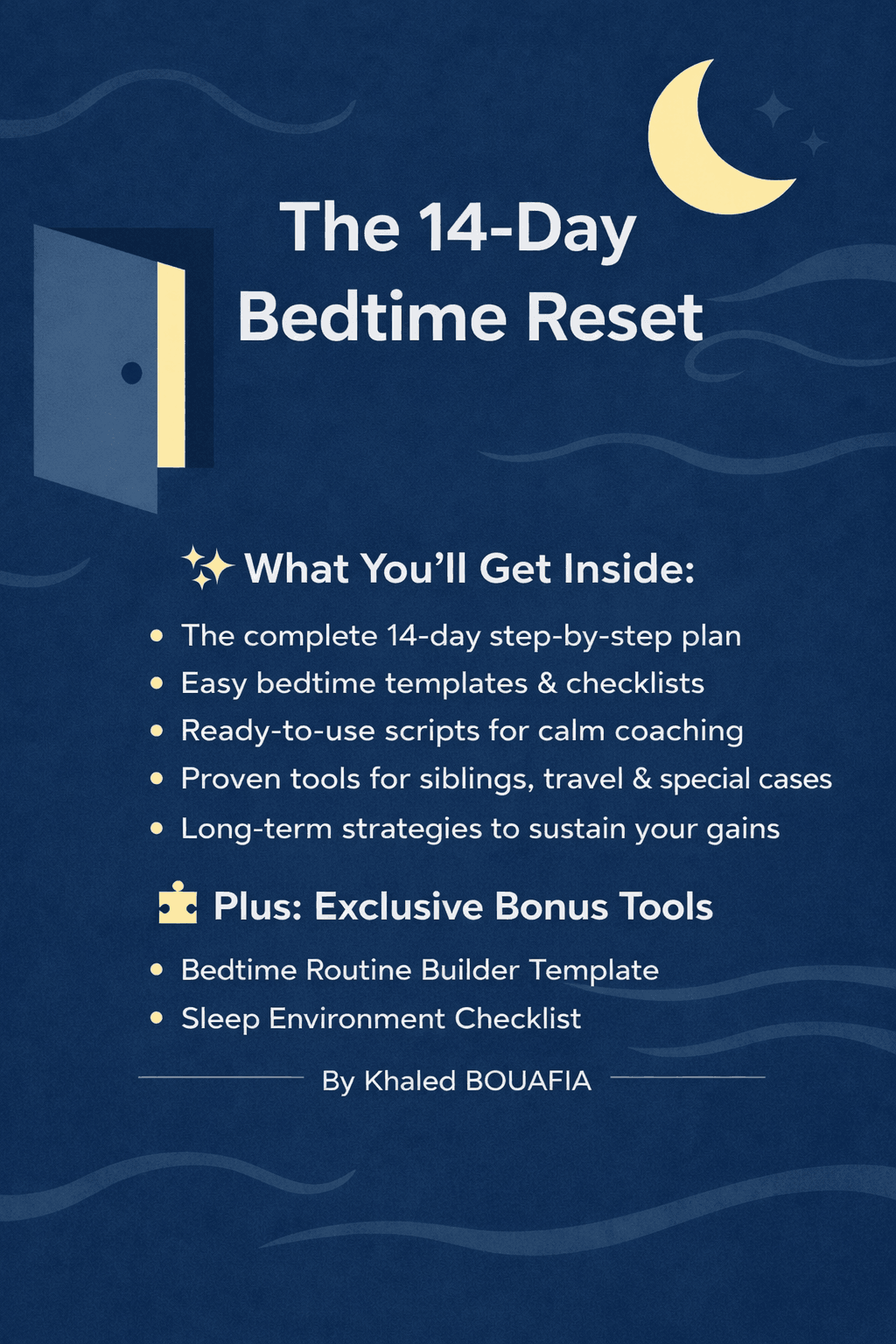
The 14-Day Bedtime Reset Sleep System for Peaceful Nights
The 14-Day Bedtime Reset Sleep System for Peaceful Nights
Couldn't load pickup availability
The 14-Day Bedtime Reset Sleep System for Peaceful Nights
🌙 THE 14-DAY BEDTIME RESET
Stop the bedtime battles. Reclaim calm, connected evenings in just 14 days.
What if bedtime no longer felt like a nightly negotiation?
No more repeated trips out of the bedroom. No more endless requests for one more story, one more hug, or one more sip of water. No more wondering whether tonight will take twenty minutes or two exhausting hours.
Imagine ending your evening knowing exactly what to do—and watching your child fall asleep calmly and consistently within 30 minutes.
The 14-Day Bedtime Reset is a practical, evidence-informed guide designed to help parents and caregivers of children ages 3 to 10 end bedtime resistance, reduce repeated get-outs, and create calm, predictable bedtime routines that actually work.
WHY BEDTIME RESISTANCE FEELS SO HARD FOR PARENTS
You've probably tried:
- Reward charts
- Longer cuddles
- Extra water breaks
- Sitting beside your child until they fall asleep
- Different bedtime strategies every few days
- Earlier bedtimes, later bedtimes, and endless negotiations
The problem isn't your parenting.
The problem is inconsistency.
When routines constantly change, children continue testing boundaries. Small requests become repeated bedtime battles, and exhausted parents lose another evening to frustration and unpredictability.
This guide replaces guesswork with a clear, compassionate, step-by-step plan that combines routine building, sleep-friendly environments, calm coaching, and measurable progress over fourteen days.
WHAT MAKES THIS BEDTIME ROUTINE GUIDE DIFFERENT?
This isn't another collection of bedtime tips.
The 14-Day Bedtime Reset is built around a complete Behavior Supported Sleep Framework that combines:
✔️ Predictable bedtime routines
✔️ Sleep-friendly environments
✔️ Calm and consistent coaching strategies
✔️ Practical data tracking and micro-wins
✔️ Ready-to-use scripts for common bedtime challenges
✔️ Long-term maintenance strategies for lasting results
You'll learn how these elements work together to reduce bedtime resistance, encourage independent settling, and support faster sleep onset without power struggles.
Calm evenings. Consistent routines. Sleep within 30 minutes.
WHAT YOU'LL DISCOVER ABOUT CHILD SLEEP, HEALTHY SLEEP HABITS AND BEDTIME ROUTINES
Inside this guide you'll learn how to:
- Build a predictable bedtime routine and bedtime schedule that works for your family
- Use visual bedtime routine charts to create consistency every night
- Reduce bedtime resistance and repeated get-outs without power struggles
- Create a sleep-friendly bedroom environment that promotes healthy sleep habits
- Learn how healthy bedtime snack strategies can help prevent hunger-related bedtime delays
- Use calm coaching techniques that preserve connection and boundaries
- Respond consistently to common bedtime challenges
- Handle night wakings with confidence
- Support greater independence at bedtime
- Maintain healthy bedtime habits long after the 14-day reset is complete
WHAT'S INCLUDED IN THE 14-DAY BEDTIME RESET
📘 The Complete 14-Day Plan
Day 0 preparation · Week 1 implementation strategies · Week 2 optimization techniques · Maintenance strategies for long-term success · Special situations guidance
🛏️ Bedtime Routine Builder Template
Visual bedtime routine charts · Visual schedules · Timing blocks · Choice boards · Boundary scripts · Caregiver alignment tools · Micro-wins tracking
🪟 Sleep-Friendly Room Setup Checklist
Light · Sound · Temperature · Comfort · Clutter · Safety supports · Sensory adjustments
💬 Quiet Return Method Scripts Guide
Validation phrases · Boundary statements · Post lights-out responses · Calm coaching scripts · Gradual fading techniques · Caregiver alignment strategies
BUILD HEALTHY SLEEP HABITS THAT LAST
Healthy sleep habits begin with consistency. Through predictable bedtime routines, sleep-friendly environments, and calm coaching strategies, The 14-Day Bedtime Reset helps families create peaceful evenings and lasting bedtime success.
IMAGINE BEDTIME FEELING LIKE THIS
Your child falls asleep calmly within 30 minutes.
Lights out no longer feels like a nightly battle.
Both caregivers follow the same simple plan every night.
Night wakings become easier to manage.
Your evenings become calm, predictable, and connected.
Small nightly wins build lasting bedtime habits.
You finally feel confident knowing exactly what to do.
Your family enjoys more peaceful evenings together.
WHO THIS CHILD SLEEP AND BEDTIME ROUTINE GUIDE IS FOR
This guide was created for:
- Parents of children ages 3 to 10
- Busy caregivers looking for practical bedtime solutions
- Co-parents struggling with consistency
- Families experiencing repeated bedtime resistance
- Children who frequently leave their bedroom after lights out
- Parents seeking compassionate, evidence-informed strategies that avoid power struggles
PEOPLE ALSO ASK
Is this guide suitable for children ages 3 to 10?
Yes. The strategies are specifically designed for children between ages 3 and 10.
Does the guide include a daily plan?
Absolutely. You'll receive a structured 14-day roadmap with clear objectives and practical implementation steps.
What if my child keeps leaving their bedroom after lights out?
The guide includes the Quiet Return Method, which provides calm, predictable responses designed to reduce repeated get-outs while maintaining connection and consistency.
Does this work for single parents and co-parents?
Yes. The guide includes caregiver alignment strategies, scripts, and practical adaptations for solo parenting and co-parenting situations.
What if my child struggles with bedtime anxiety?
Special situations chapters address challenges such as anxiety, night wakings, travel, illness, sibling dynamics, and neurodiversity with practical adaptations.
Is this approach gentle?
Yes. The entire framework emphasizes calm coaching, warm boundaries, predictable routines, and compassionate responses rather than punishment or power struggles.
How long does the bedtime routine take?
Most bedtime routines are designed to last approximately 25 to 40 minutes, depending on your child's needs and developmental stage.
EVIDENCE-INFORMED APPROACH TO CHILD SLEEP
The strategies presented throughout this guide are informed by decades of pediatric sleep research and evidence-based behavioral approaches to bedtime resistance, bedtime routines, sleep onset, and night wakings in young children.
The framework draws upon research published in leading scientific journals and clinical resources, including:
Sleep Medicine Reviews · Sleep · Journal of Pediatric Psychology · Physiological Reports · Current Problems in Pediatric and Adolescent Health Care · The International Classification of Sleep Disorders (American Academy of Sleep Medicine)
Research topics include:
- Consistent bedtime routines and healthy sleep outcomes
- Behavioral treatment approaches for bedtime resistance and night wakings
- The Bedtime Pass Method for reducing repeated get-outs
- Evening light exposure and melatonin regulation in children
- Evidence-based pediatric sleep interventions and caregiver coaching strategies
This guide combines compassionate parenting principles with practical, evidence-informed strategies that busy families can confidently implement every night.
🌙 YOUR EVENINGS BELONG TO YOU AGAIN
No more bedtime negotiations.
No more repeated get-outs.
No more wondering what will work tonight.
Just calm routines. Clear boundaries. Predictable evenings.
And a child who knows exactly what comes next.
Begin your 14-Day Bedtime Reset tonight and reclaim calm, connected evenings for your entire family.